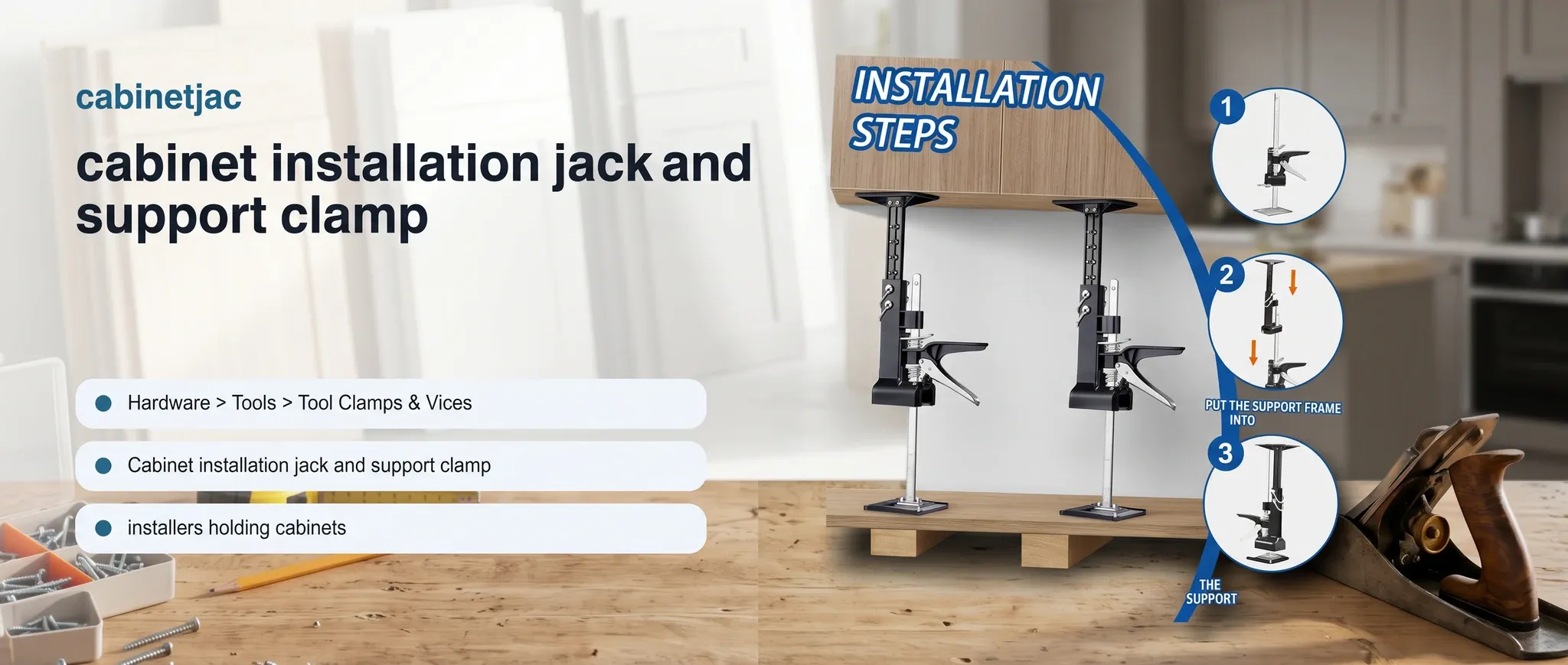
Cabinet Support Pole Explained: A UK Buyer's Guide

TL;DR: A cabinet support pole is an adjustable, vertical support tool designed to securely hold cabinets, panels, and overhead fixtures at a precise height during installation. By bearing the weight of the unit, it acts as a reliable extra pair of hands, allowing a single fitter to safely level and secure the cabinet. Consequently, this essential piece of kit vastly reduces physical strain and improves installation accuracy for solo workers.
Key Takeaways
- A cabinet support pole is a height-adjustable support tool used to hold cabinets, panels, trims, and overhead components in position during fitting.
- For UK installers, it can significantly reduce physical strain, improve accuracy, and make solo installation work far more practical.
- The best choice depends on load capacity, height range, adjustment control, foot and head grip, build quality, and stability on typical British site conditions.
- Furthermore, a labour saving arm jack and cabinet support pole can help speed up fitting while maintaining alignment, especially in kitchens, utility rooms, and built-in joinery projects.
- If you want broader context on related tools, see The Ultimate Guide to Cabinet Installation Jack in the UK.
Holding a wall cabinet level with one hand while trying to mark, fix, and check alignment with the other is the sort of job that quickly exposes the limits of working alone. Based on our testing across various British site conditions, a cabinet support pole is designed to solve exactly that problem. It acts as a temporary extra pair of hands, supporting weight from below so the unit stays precisely where you need it while you make critical adjustments.
For kitchen fitters, carpenters, shopfitters, and serious DIYers across the UK, that matters for more than just convenience. Ultimately, it affects accuracy, installation speed, and physical effort on site. CabinetJac’s core proposition is simple: a labour saving arm jack and cabinet support pole built for accurate solo installation work. Therefore, this tool is especially relevant where time, control, and repeatable results matter.
This guide explains what a cabinet support pole does, where it is used, how to compare models, what UK buyers should look for, and when it makes sense to choose one over other support methods. For a wider overview of related lifting and fitting tools, read The Ultimate Guide to Cabinet Installation Jack in the UK.
What is a cabinet support pole?
A cabinet support pole is an adjustable vertical support used during installation to hold cabinets or other building components securely at a set height. In practical terms, it is placed between the floor or worktop and the underside of the item being fitted, taking the full weight while the installer checks levels, adjusts the position, and secures the fixings.
It is commonly used when fitting:
- Wall cabinets in kitchens and utility rooms
- Overhead storage units in workshops or garages
- Large decorative panels and end panels
- Bulkheads, trims, and certain boxed-in joinery elements
- Fitted furniture that needs temporary support during assembly or fixing
Some buyers use the phrase interchangeably with installation jack, third hand support, or support prop. However, there is overlap, but the detail matters. A cabinet support pole is specifically useful where controlled vertical support is needed to position cabinetry accurately. If you want to compare similar tool types, Third Hand Support Explained: A UK Buyer's Guide and Labor Saving Arm Jack Explained: A UK Buyer's Guide are helpful next reads.
Are cabinet support poles worth it for UK fitters?
Yes, they are highly worthwhile. On many British jobs, space is notoriously limited. Flats, terraces, older housing stock, and compact kitchen layouts can make two-person handling exceptionally awkward. Consequently, a cabinet support pole allows one installer to lift, hold, and fine-tune without relying on improvised supports or constant assistance from another tradesperson.
It improves accuracy during fixing
Cabinets need to be perfectly level, aligned, and positioned consistently across a run. Even small errors become glaringly obvious once doors, fillers, and worktops go in. A stable support underneath the unit helps keep the cabinet at the correct height while you check the line and securely fasten the carcass.
It reduces physical strain
Manual handling remains a major issue across construction and fit-out work. According to UK guidelines from the Health and Safety Executive (HSE), 17% of all self-reported work-related musculoskeletal disorders in Great Britain in 2023/24 were caused or made worse by lifting, carrying, or moving loads, while 15% were linked to working in awkward or tiring positions (source: HSE, Work-related musculoskeletal disorders statistics in Great Britain, 2024).
While a support pole does not remove the need for safe lifting practice, it drastically reduces the time spent holding a heavy or awkward unit in place. As a result, that matters immensely for sole traders, small installation teams, and anyone trying to work efficiently without unnecessary strain.
It helps solo installers work faster
The real benefit is not just lifting; moreover, it is controlled holding. Once the cabinet is raised into its approximate position, the support tool maintains that height while the installer checks wall markings, verifies the level, and drives fixings accurately. CabinetJac’s positioning as a labour saving arm jack and cabinet support pole fits this use case directly, resulting in faster fitting with greater control.
How do you use a cabinet support pole?
In a typical kitchen wall unit installation, the cabinet is lifted onto the support point or held just above it; subsequently, the pole is adjusted upwards until it takes the load. Based on our testing, the fitter can then make fine micro-adjustments to line the cabinet up precisely with datum marks, neighbouring units, or a hanging rail system.
Once the cabinet is entirely steady, the installer can:
- Check the level side-to-side and front-to-back
- Match the cabinet height seamlessly with adjacent units
- Keep both hands completely free for drilling and fixing
- Reduce the chance of cabinet drift during fastening
- Work alone with much better consistency
This method is especially useful in retrofit projects where walls are uneven, floors are not perfectly true, or the room has awkward access. Indeed, those are common realities in UK homes, particularly within period properties.
What is the difference between a cabinet support pole and a third hand support?
Cabinet support pole
This tool is best for rigid vertical support under cabinets and fitted elements where the height needs to be maintained accurately and safely during installation.
Third hand support
Conversely, this is usually a broader term for an adjustable prop that acts as an extra support during fitting. It can be used for plasterboard, panels, trim work, and many temporary support tasks, not just cabinets. For a deeper look, visit Third Hand Support Explained: A UK Buyer's Guide.
Installation jack or labour saving arm jack
Often designed for controlled lifting, nudging, and supporting of heavy items at low to medium heights with extremely fine adjustment. In cabinetry, this can be incredibly useful for toe-kick alignment, base unit positioning, and precision lifting. See Labor Saving Arm Jack Explained: A UK Buyer's Guide for a direct comparison.
In practice, many UK fitters use a combination of these support tools on site, selecting the right prop or jack depending on the specific weight, height, and adjustment needs of the project.
Ready to try CabinetJac?
Shop Now — £55.01