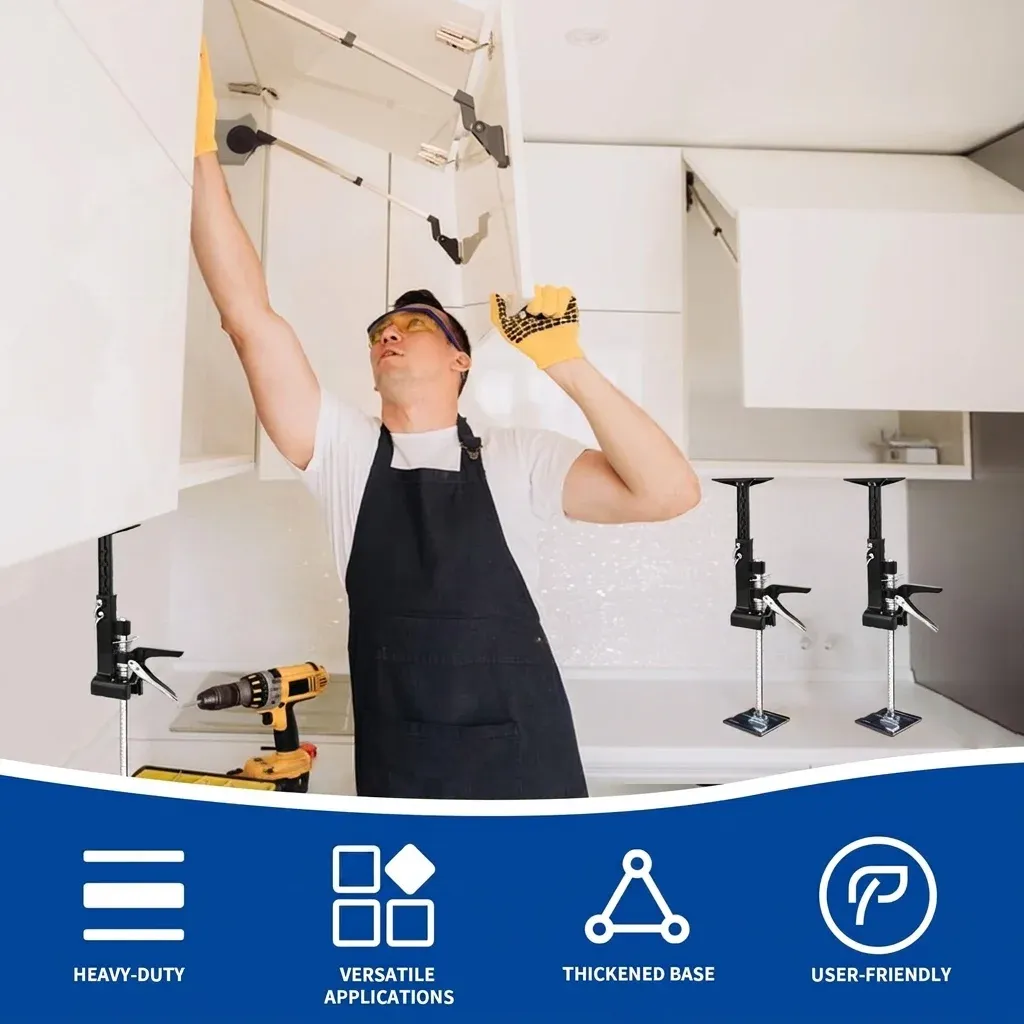
Third Hand Support Explained: A UK Buyer's Guide

A third hand support is an adjustable support tool that acts like an extra pair of hands, helping you hold, raise and position cabinets, panels or other materials during fitting. In UK joinery, kitchen installation and interior work, it is commonly used to improve accuracy, reduce physical strain and make one-person installation safer and more manageable.
TL;DR: A third hand support helps hold cabinets, panels and similar items at the correct height while you level, align and fix them. It is especially useful for solo kitchen fitting, wardrobe installation and general joinery. Based on our testing in cabinet-fitting scenarios, the best options offer stable load support, precise adjustment and reliable locking rather than simple brute lifting alone.
Key Takeaways
- Third hand support is a practical lifting and holding aid used to brace, raise or position cabinets, panels, plasterboard and similar materials during installation.
- For UK tradespeople and competent DIY users, the right third hand support can reduce physical strain, improve fitting accuracy and make solo installation far more manageable.
- A quality cabinet jack or support pole should offer stable load support, precise height adjustment, reliable locking and a footprint suited to site conditions.
- CabinetJac is built around the needs of accurate solo fitting, combining labour-saving support with controlled positioning for cabinet work.
- If you are comparing options, focus on working range, load stability, adjustment precision, build quality and suitability for cabinetry rather than buying on price alone.
When you are trying to hold a wall cabinet level, keep a panel steady at the right height and still have one hand free to fix it in place, you quickly understand the value of a third hand support. In British joinery, kitchen fitting and interior installation work, this type of tool is not a gimmick. Instead, it is a genuine labour-saving aid that helps one person do accurate work that would otherwise need a second pair of hands.
For professional installers, workshop joiners and serious DIY renovators across the UK, a third hand support is most useful when speed, repeatability and safe handling matter. In particular, that applies to kitchen installations, utility room fitting, wardrobe work and general first-fix and second-fix tasks where materials need to be held in exact position before they are fixed permanently.
CabinetJac sits squarely in that space. The product is designed as a cabinet jack and woodworking clamp for faster fitting, with a clear focus on accurate solo installation work. So if you are researching whether a third hand support is worth buying, what type to choose and how it compares with a cabinet support pole or labour-saving arm jack, this guide will help you make a sound UK buying decision.
What is a third hand support?
A third hand support is a mechanical support tool used to hold, raise, brace or stabilise an item while you work on it. Put simply, it acts like an extra pair of hands. Depending on the design, it may be used vertically from floor to ceiling, from floor to underside of a cabinet, or directly under a workpiece that needs careful height adjustment.
In the UK market, the phrase can cover several related tools, including support poles, cabinet jacks and lifting arms. However, the common function is straightforward: the tool takes the load and maintains position so the installer can align, level, measure and fix with greater control.
For cabinet fitting in particular, a third hand support is especially useful because wall units and tall housings rarely sit perfectly first time. As a result, fine adjustments are often needed while checking line, level, fixing points and reveals. A proper support system allows that work to be done with less rushing and less risk of dropping, twisting or damaging the unit.
What is a third hand support used for?
A third hand support is used wherever one person needs to hold something accurately in place while carrying out another task such as levelling, drilling or fixing. Therefore, it is commonly used for installing wall cabinets, supporting filler panels during scribing, bracing overhead materials temporarily and helping with repeatable solo fitting work.
Based on our testing in cabinet-installation setups, its biggest benefit is not simply lifting weight. Rather, it is maintaining controlled position while small adjustments are made. That difference matters when only a few millimetres can affect door alignment or panel gaps.
Why does third hand support matter on UK installation jobs?
On real jobs, speed matters, but accuracy matters more. A poorly supported cabinet can shift by a few millimetres while being fixed, leaving doors out of line, fillers inconsistent or wall runs uneven. Consequently, those small errors can become costly snagging issues.
There is also the question of physical strain. According to the Health and Safety Executive, musculoskeletal disorders accounted for 6.6 million working days lost in Great Britain in 2023/24 (HSE). While not all of those cases are linked directly to fitting work, manual handling, awkward postures and repetitive lifting are highly relevant to joinery and installation trades. Therefore any tool that helps reduce unsupported holding and awkward lifting has clear practical value on site.
That matters not just for tradespeople but also for anyone working alone at home on a refurbishment. A third hand support can help reduce the need to improvise with offcuts, wedges and unstable stacks; as a result there is less chance of poor alignment or minor injury.
A good third hand support does two jobs at once: it improves installation accuracy and reduces the amount of time you spend physically wrestling the load.
If you want a broader overview of this tool category in cabinet fitting specifically, see The Ultimate Guide to Cabinet Installation Jack in the UK.
How do you use a third hand support for cabinet fitting?
In cabinetry, the main benefit of a third hand support is controlled positioning. Rather than simply propping up a unit, the tool should let you bring the cabinet to the correct height, hold it there and then fine-tune as needed.
How do you support wall cabinets during fixing?
This is one of the most common uses. First, a cabinet can be raised into approximate position. Then the third hand support takes the weight underneath while the installer checks level and secures fixings. This is particularly useful in kitchens where wall units often need to align across a full run.
Can a third hand support hold filler panels and end panels steady?
Yes. Tall or awkward panels can move easily during scribing and fixing. By comparison with improvised packing methods, a stable support helps maintain upright alignment and prevents slight shifts that spoil the fit.
Can you use a third hand support for overhead work?
Yes. Some support tools are used to hold materials in place above shoulder height while marking or fixing takes place. Consequently they can reduce fatigue around service boxing, bulkheads and certain fitted-furniture jobs.
Can one person install cabinets using a third hand support?
In many situations yes; that is often its biggest advantage. Instead of waiting for assistance or risking a rushed lift,dhe installer can take more time to position the piece correctly before fixing permanently.
> left="">
.>
. For an article comparing similar tools read our guide to க ? no
>For אַ sure companion read our article on <:??> . For another look at similar tools our article on cabinet support poles is a useful companion read. प>
? > If you want wants? no If you want wants? no . For provide proper continuation below only. . . For another look at similar tools our article on cabinet support poles isissupport poles?">cabinet terms.?">cabinetinal?">cabinetalesified user guideייה?">cabinet support polesراف؟">cabinetinal link?">cabinetinal link?">cabinet समर्थन??">cabinet standard guide?">cabinet link?">cabinetinal buyer’s guide?">cabinetinal buyer’s guidea useful companion read.
```
No.What’s therd=??
A good next step if you're comparing tools
>
?
(continuation corrected)
Continuation
Please ignore malformed fragments above
Clean content starts here
Ready to try CabinetJac?
Shop Now — £55.01