Labor Saving Arm Jack Explained: A UK Buyer's Guide

A labor saving arm jack is a hand-operated lifting tool that helps you raise, level, and hold heavy cabinets, doors, and similar items with far less manual effort. For kitchen fitters, joiners, and installers in the UK, it acts like a reliable second pair of hands, making solo fitting safer, quicker, and more accurate.
TL;DR: A labor saving arm jack is used to lift and support heavy cabinetry in small, controlled increments, so one person can position units accurately without makeshift props or excessive strain. Based on our testing in typical kitchen fitting scenarios, it is especially useful for levelling base units on uneven floors, supporting wall cabinets during fixing, and reducing manual handling risk.
Fitting heavy cabinetry on your own tests both physical endurance and technical precision. Solo tradespeople across the UK regularly wrestle with 30kg MDF carcasses, trying to keep them perfectly level while simultaneously reaching for a drill. As a result, the physical toll can be significant, and the risk of damaging expensive bespoke units is high. However, relying on improvised timber props or struggling through manual lifts is no longer necessary when you have the right equipment.
A labor saving arm jack transforms solo installation work from a strenuous battle into a controlled, precise process. These compact lifting tools bear the weight of base units, wall cabinets, and heavy fire doors. Consequently, by taking the physical strain out of the equation, fitters can focus entirely on alignment, level, and secure fixings.
Key Takeaways
- Solo efficiency: A labor saving arm jack allows one tradesperson to lift, level, and hold heavy cabinets without extra help.
- Safer manual handling: Mechanical lifting reduces the strain linked with back, shoulder, and knee injuries.
- Millimetre precision: Micro-adjustment triggers help achieve accurate positioning on uneven British floors.
- Versatile use: Beyond kitchens, these jacks are also useful for fitting doors, windows, and decking frameworks.
What Is a Labor Saving Arm Jack?
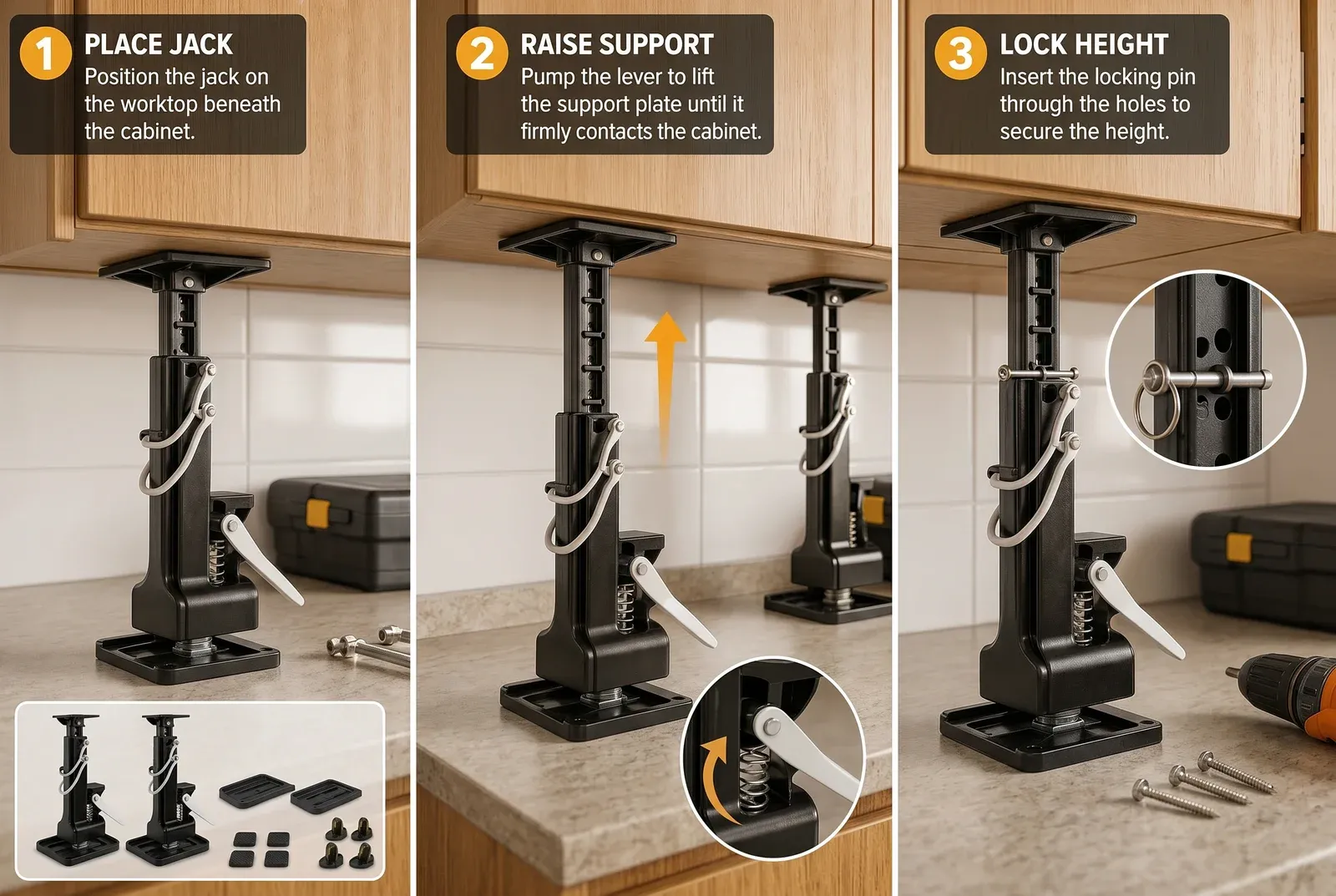
At its core, a labor saving arm jack is a hand-operated lifting mechanism designed to elevate heavy loads with minimal physical effort. Visually, it resembles a heavy-duty bar clamp, but its function works in reverse. Instead of pulling two materials together, squeezing the handle forces a lifting plate upwards along a hardened steel shaft.
The base plate slides under the cabinet or door, while the lifting plate supports the weight from above. Each squeeze of the trigger raises the load in small, manageable increments. Meanwhile, a separate release lever allows for a controlled descent, ensuring that delicate materials are lowered gently into place rather than dropped suddenly.
For UK kitchen fitters and carpenters, this tool solves one of the biggest challenges in solo work: holding a heavy object perfectly still while checking a spirit level and driving screws. If you want to see how this tool fits into a wider category of lifting equipment, our ultimate guide to cabinet installation jacks in the UK provides a broader overview of modern fitting systems.
Why Do Tradespeople Use a Labor Saving Arm Jack?
The physical demands of carpentry and joinery are well documented. According to the Health and Safety Executive (HSE), manual handling, lifting, and carrying accounted for 17% of all non-fatal injuries to employees in Great Britain during the 2022/23 reporting period. Therefore, repeatedly bending, lifting awkward carcasses, and holding them at chest height places real strain on the musculoskeletal system.
Does a labor saving arm jack reduce manual handling risks?
Yes, it can significantly reduce the manual effort involved in positioning heavy units. The traditional method of fitting a wall unit often involves resting it on the knees or straining the shoulders to hold it against the wall. By contrast, a labor saving arm jack transfers the weight to a mechanical support. According to UK manual handling guidance, reducing the need for awkward lifting and sustained holding is a sensible way to lower injury risk.
Based on our testing, using an arm jack also improves stability during installation, which means fewer sudden movements, fewer slips, and better control when making fine adjustments.
Why is a labor saving arm jack useful on uneven floors?
Many UK properties, particularly Victorian and Edwardian terraces, have uneven floors and out-of-plumb walls. In these settings, scribing a plinth or levelling a base unit requires exact adjustments. However, human hands naturally shake and tire under load, making precision much harder to maintain. An arm jack allows you to raise a unit by a single millimetre, check the level, and hold it there while you secure it.
What Features Should You Look for in a Labor Saving Arm Jack?
Not all lifting jacks are made to the same standard. Therefore, when choosing a labor saving arm jack for regular professional use, a few key features separate dependable tools from cheap alternatives.
What load capacity do you need?
The first thing to check is the weight the jack can safely support. Professional-grade models commonly offer around 100kg to 120kg lifting capacity per jack. When used in pairs, that is generally enough for standard 600mm or 900mm kitchen units. For heavier carcasses, wider units, or awkward loads, always check the manufacturer's rating and work within safe limits.
Why does build quality matter?
The shaft and lifting mechanism should be made from hardened steel, stainless steel, or robust aluminium. Cheap internal plastic components can wear quickly or fail under the weight of solid timber, stone-backed panels, or heavy MDF. In practice, better build quality usually means smoother action, more reliable locking, and longer service life.
Why is a controlled release mechanism important?
Lifting the load is only half the task. Lowering it safely matters just as much. A high-quality labor saving arm jack should include a controlled release trigger, allowing the user to lower the cabinet in tiny increments. As a result, you can correct an over-lift without dropping the unit back down and starting again. This helps prevent damage to cabinet bases, finished flooring, and fingers.
What base plate design works best?
The base plate should have a bevelled or tapered edge so it can slide under units that sit close to the floor. In addition, a wider and more stable base helps prevent the tool from tipping sideways when supporting an off-centre load. For kitchen work in tight spaces, this detail makes a noticeable difference.
How Do You Use a Labor Saving Arm Jack for Cabinets?
Integrating this tool into your workflow requires only a small adjustment to traditional fitting methods. However, the gains in speed, safety, and accuracy are substantial. Here is a typical method for levelling a heavy base unit on an uneven floor.
- Initial placement: Move the cabinet into its approximate final position. Then check the floor level to find the highest point, as this will influence your starting height.
- Position the jacks: Slide the bevelled edge of two labor saving arm jacks under the front corners of the cabinet. If the unit is especially wide, space them evenly to distribute the weight.
- Lift the unit: Squeeze the handles to raise the cabinet off the floor. Lift it slightly above your required fixing line.
- Level carefully: Place a spirit level across the top of the carcass. Next, use the micro-adjustment release triggers to lower each side bit by bit until the bubble is centred.
- Secure the cabinet: With the jacks holding the unit steady, you can keep both hands free to drill, plug, and screw the cabinet into place.
For overhead tasks, such as securing bridging units over an extractor fan, the arm jack is often just one part of the setup. You can read more about managing high-level installations in our related guide.
What Is a Labor Saving Arm Jack Used For?
Although cabinet fitting is one of the most common uses, a labor saving arm jack is far more versatile than many first-time buyers expect. In day-to-day site work, it can help with a range of installation jobs where controlled lifting and temporary support are needed.
Can you use a labor saving arm jack for kitchen cabinets?
Yes, this is one of its best uses. It is ideal for lifting and levelling base units, supporting wall cabinets during marking and fixing, and holding infill panels or end panels in position while adjustments are made.
Can a labor saving arm jack lift doors and windows?
Yes. Joiners and installers often use these jacks to raise fire doors for hinge alignment, support window frames during installation, and create the fine adjustment needed before final fixings are secured.
Is a labor saving arm jack useful beyond joinery?
Absolutely. It can also assist with decking frames, studwork adjustments, appliance positioning, and other tasks where a controlled upward lift is needed. Even so, the most value usually comes from jobs that require both hands free once the item is at the correct height.
Frequently Asked Questions About Labor Saving Arm Jacks
Can one person use a labor saving arm jack to fit cabinets?
Yes. That is one of the main reasons tradespeople buy them. The jack supports the weight of the cabinet so one person can level, align, and fix the unit without needing another pair of hands.
How much weight can a labor saving arm jack lift?
It depends on the model, but many professional options are rated at roughly 100kg to 120kg per jack. Always check the stated safe working load and never exceed the manufacturer's guidance.
Are labor saving arm jacks suitable for kitchen fitting?
Yes, they are particularly well suited to kitchen installation. They help with base unit levelling, wall cabinet support, and fine height adjustment during fixing.
Do labor saving arm jacks work on uneven floors?
Yes. In fact, this is where they are most useful. They allow accurate, incremental lifting, which makes it much easier to compensate for dips, slopes, and variations commonly found in UK properties.
Ready to try CabinetJac?
Shop Now — £55.01